
| Prof. Wei XuInstitute of Electrical Engineering, Chinese Academy of Sciences, China (IEEE Fellow, IET Fellow) Wei Xu (Fellow, IEEE) received the double B.E. and M.E. degrees from Tianjin University, Tianjin, China, in 2002 and 2005, respectively, and the Ph.D. degree from the Institute of Electrical Engineering, Chinese Academy of Sciences (IEECAS), Beijing, China, in 2008, all in electrical engineering. His research topics mainly focus on the design and control of linear machines and drives. From Sep. 2008 to Sep. 2013, he was a Post-Doctoral Fellow with the University of Technology Sydney, Ultimo, NSW, Australia, the Vice-Chancellor Research Fellow with the Royal Melbourne Institute of Technology, Melbourne, VIC, Australia, and a Japan Science Promotion Society Invitation Fellow with Meiji University, Tokyo, Japan, respectively. From Oct. 2013 to Dec. 2023, he was a Professor with the Huazhong University of Science and Technology, Wuhan, China. Since Jan. 2024, he has been a Professor with IEECAS.Dr. Xu is Director for State Key Laboratory for High Density Electromagnetic Power and Systems, IEEE Fellow and IET Fellow. He is General Chair of 2021 International Symposium on Linear Drives for Industry Applications and 2023 IEEE International Conference on Predictive Control of Electrical Drives and Power Electronics. He is one Associate Editor of over ten peer-reviewed IEEE JOURNALS, including IEEE TRANSACTIONS ON INDUSTRIAL ELECTRONICS and IEEE TRANSACTIONS ON POWER ELECTRONICS. He has published 10 books, over 180 journal papers in IEEE Series, and been awarded more than 150 intentional patents granted, which has been cited by over 1,1000 times with H-index 52 based on Google Scholar statistics. |
| Prof. Chun Sing LaiTianjin University, China (TC Co-Chair of Intelligent Power and Energy Systems of IEEE Systems, Man, and Cybernetics Society) Prof. Chun Sing Lai received his B.Eng. (First Class Hons.) in electronic and electrical engineering from Brunel University London in 2013 and his D.Phil. in engineering science from the University of Oxford in 2019. He is currently a Yingcai Professor at the School of Electrical and Information Engineering, Tianjin University. His research focuses on smart grid, energy system modeling, computational intelligence, and electric vehicle systems. Prof. Lai has organized and chaired various IEEE workshops and conferences related to smart cities and smart grids, including roles as Publications Co-Chair and Technical Program Co-Chair for the IEEE International Smart Cities Conference, and Conference Chair for the 2024 International Conference on Intelligent Computing and Human-Computer Interaction. He serves as Vice-Chair of the IEEE Smart Cities Publications Committee, Senior Editor for IEEE Transactions on Consumer Electronics, and Associate Editor for IEEE Transactions on Systems, Man, and Cybernetics and IET Energy Conversion and Economics. He also chairs IEEE working groups P2814 and P3166 and leads the IEEE/SMCS Intelligent Power and Energy Systems Technical Committee. His honors include the 2020 Best Paper Award at IEEE ISC2, the 2022 IEEE SMC Society Meritorious Service Award, the 2024 IEEE Most Active SMC Technical Committee Award, the 2025 Chester W. Sall Memorial Award, Best Associate Editor and Excellent Reviewer Awards in 2024, and the IEEE SMC Early Career Award in 2025. He co-authored the book *Smart Energy for Transportation and Health in a Smart City* (IEEE Press/Wiley, 2023) and has six highly cited journal papers on Web of Science. Since 2021, he is ranked among the top 2% of active scientists worldwide by Stanford University. He is a Senior Member of IEEE, UK Chartered Engineer, and Fellow of the Higher Education Academy, UK. |
| Assoc. Prof. Chang ZhaiHarbin Engineering University, China Chang ZHAI, male, Associate Professor at Harbin Engineering University. He obtained his PhD degree from Hiroshima University, Japan, and subsequently conducted postdoctoral research at Hiroshima University and the National Institute of Advanced Industrial Science and Technology (AIST) of Japan. In 2024, he was selected for the National Overseas Young Talents Program. His main research interests focus on zero-carbon fuel utilization and high-efficiency atomization and combustion in internal combustion engines. Up to now, he has published more than 20 SCI-indexed papers, among which 13 were authored as the first or corresponding author. He serves as a Guest Editor for the international journals Green Energy and Resources and Processes. As the technical principal, he has participated in 6 national projects funded of Japan, as well as 5 projects with Fortune Global 500 enterprises including Yanmar, Isuzu and Mazda. He has also completed one open fund project of the National Key Laboratory as the technical principal. Speech Title: Application of Zero-Carbon Fuels: Research on Combustion and Atomization Technologies of Hydrogen-Ammonia Fuels |

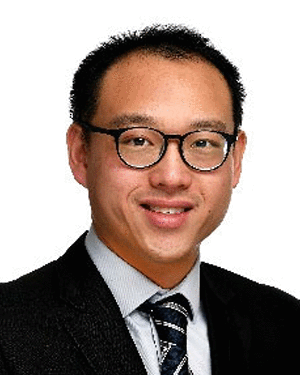
| Prof. Xiaoming KangUniversity of South China, China Leader of the New Energy Power and Energy Storage Team Dr. Kang achieved his bachelor and Ph.D degree in Material Sciecne and Engineering, Southwest Jiaotong University in 2011 and 2017, respectively. After graduation, he further served as a postdoc and research fellow in Prof. Luo Jinglli’s group (Fellow of the Canadian Academy of Engineering) to fufil my job in the research of next generation energy conversion and storage devices, with an emphasis on exploring the oxygen evolution/reduction reaction and electrochemical carbon dioxide conversion at room temperatures. In 2022, he worked as an associated professor in School of Mechanical Engineering, University of South China. Till now, he hosted a National Natural Science Foundation of China, Shenzhen Postdoctoral innovative research programme, respectively. As a core-participant, he is a member in Shenzhen Innovative Research Team Program: Hydrogen energy and fuel cell electrocatalytic materials and Innovative project of Shenzhen graphene manufacturing innovation center: Development of graphene-based materials for anti-corrosion and antifouling of marine equipment and facilities, respectively. Besides, he once hosted a China Postdoctoral Science Foundation in 2019. Till now, he has published over 30 papers and 5 patents in Nature Communications, Chemical Communication, Polymer Chemistry, Journal of Material Chemistry A, Journal of Alloys and Compounds, Chinese Chemical Letters and etc. |
